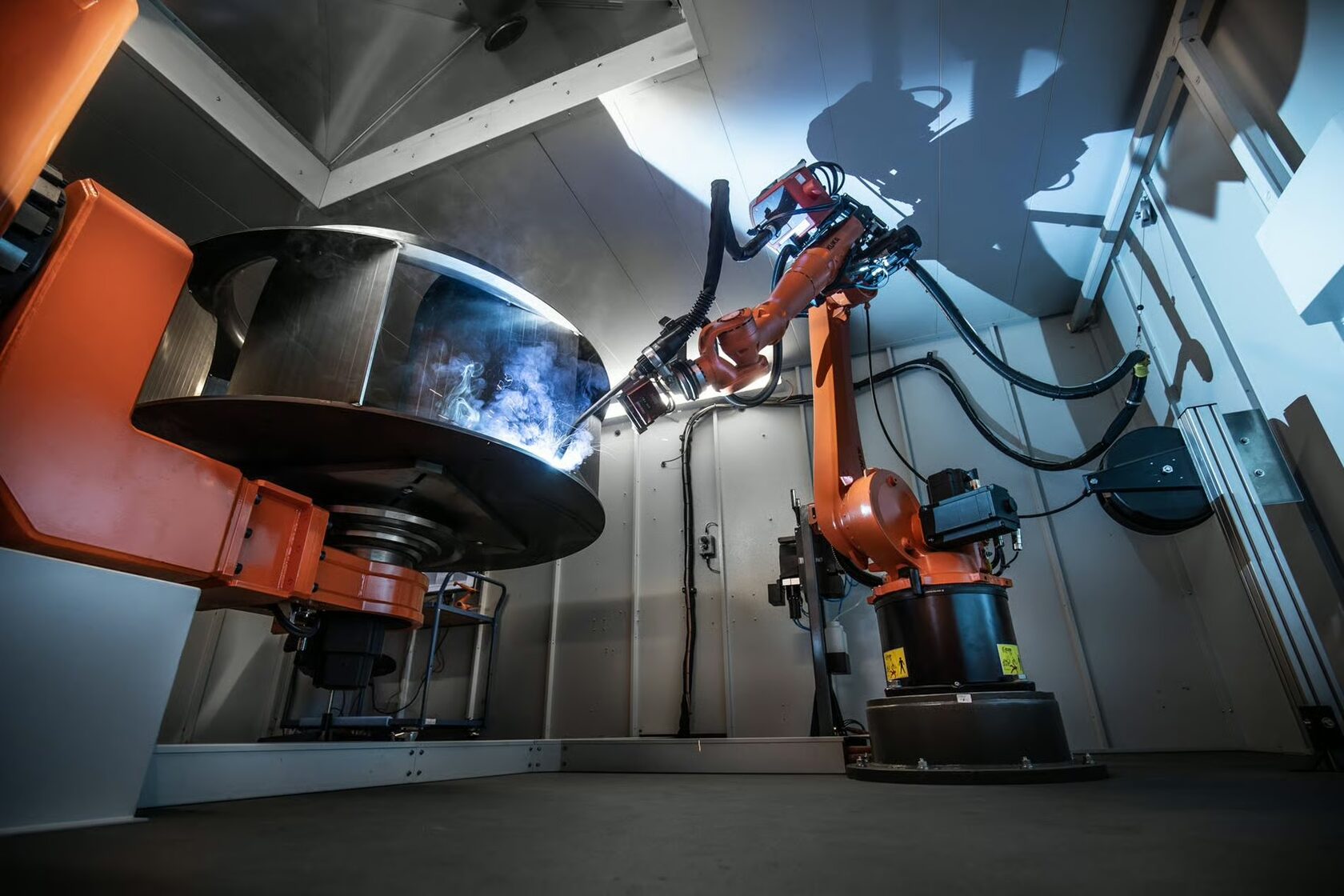
Robotic Welding: Why Businesses Need It and How It Works
Introduction
Welding is a critical process in machine building and metalworking. Shortage of skilled welders, high labor costs, and strict quality demands push companies toward automation.
The solution is robotic welding cells — automated systems that ensure consistent quality, high productivity, and safer working conditions.
Why Companies Choose Robotic Welding
- Consistent weld quality — independent of human factors.
- Fewer defects and rework — precise trajectories and stable parameters.
- Higher productivity — robots work 24/7 with minimal downtime.
- Cost savings — reduced labor dependency and training costs.
- Worker safety — less exposure to heat, fumes, and hazards.
💡 According to the International Federation of Robotics (IFR), robotic welding reduces defects by up to 70% and increases productivity by 20–40%.
How a Robotic Welding Cell Works
- Part loading — manually or automatically with positioners and manipulators.
- Fixturing — securing parts for accuracy.
- Trajectory programming — offline (CAD/CAM) or online via teach pendant.
- Seam tracking:
- laser sensors,
- arc sensors,
- wire touch sensing — the robot detects seam coordinates with welding wire.
- Welding process — MIG/MAG, TIG, spot, or laser welding.
- Automatic torch cleaning station — removes spatter and ensures arc stability.
- Quality control — visual inspection or sensor/camera systems.
Key Industries
- Metal structures (frames, beams, construction).
- Automotive and machinery (chassis, bodies, parts).
- Pipelines and tanks.
- Furniture and appliances.
Welding Power Sources for Robotic Cells
- Fronius (Austria) — premium arc welding solutions.
- Lincoln Electric (USA) — reliable multi-process systems.
- EWM (Germany) — energy-efficient industrial sources.
- Megmeet (China) — cost-effective MIG/MAG solutions.
- Kemppi (Finland) — compact, flexible systems.
These sources integrate with robots from KUKA, Fanuc, Yaskawa, ABB, ensuring stable arc ignition, precise parameter control, and seam-tracking compatibility.
Steps to Implement Robotic Welding
- Process analysis — parts, volumes, cycle times.
- Feasibility & ROI study.
- Robot and power source selection (Fronius, Kemppi, etc.).
- Cell design — fixtures, positioners, safety enclosures, fume extraction.
- Integration & programming — offline programming and on-site tuning.
- Staff training.
- Pilot production — parameter tuning, cycle optimization.
- Full deployment — MES/ERP integration.
Benefits of a Complete Solution
- Seam tracking even with part deviations.
- Torch cleaning station ensures stable operation.
- MES integration for real-time monitoring.
- Expandable with multiple robots, positioners, vision systems.
Conclusion
Robotic welding is not just an alternative to manual labor but a strategic investment. Companies gain consistent quality, higher productivity, and independence from labor shortages.
ROI is typically achieved within 1–3 years.
📩 Interested in robotic welding for your production? Contact Vexor engineers — we design and deliver turnkey robotic welding cells with Fronius, Lincoln, EWM, Megmeet, and Kemppi systems.
